Heat Waves Challenge Nuclear Plants in
Extreme heat waves in Europe have forced several nuclear plants to shut down or reduce output due to high river temperatures and low water levels, raising
Next Upcoming
Rural America & The Clean Energy Transition at Climate Week NYC
By Canary Media
Europe’s increasingly hot summers come with a worrying trend. The air conditioning that the continent long eschewed as an American indulgence is becoming a necessity, and some of the nuclear reactors needed to run those cooling units are tapping out right as thermometers spike. This summer was especially bad: The series of extreme heat waves that roasted Europe, killing thousands and fueling historic wildfires, also severely impacted the rivers that provide water to cool thermal power plants such as nuclear stations.
In France and Switzerland, nuclear plants went offline as river temperatures rose, to prevent the discharge of warm water into sensitive aquatic ecosystems. In Romania, Hungary, and Bulgaria, nuclear plants built along the Danube River either shut down or reduced output as drought dropped the water levels below intake pumps.
Critics of nuclear power have seized on the moment to challenge whether nuclear energy is as reliable and efficient as its supporters claim.
“Strange that anyone would support new nuclear, which depends on cooling, in the face of an ongoing superlinear global temperature rise,” Mark Z. Jacobson, a Stanford University professor who has long advocated for replacing atomic energy with renewables such as wind, solar, and hydropower, wrote in a post on X after France took 6.3 gigawatts of nuclear plants offline amid the heat wave.
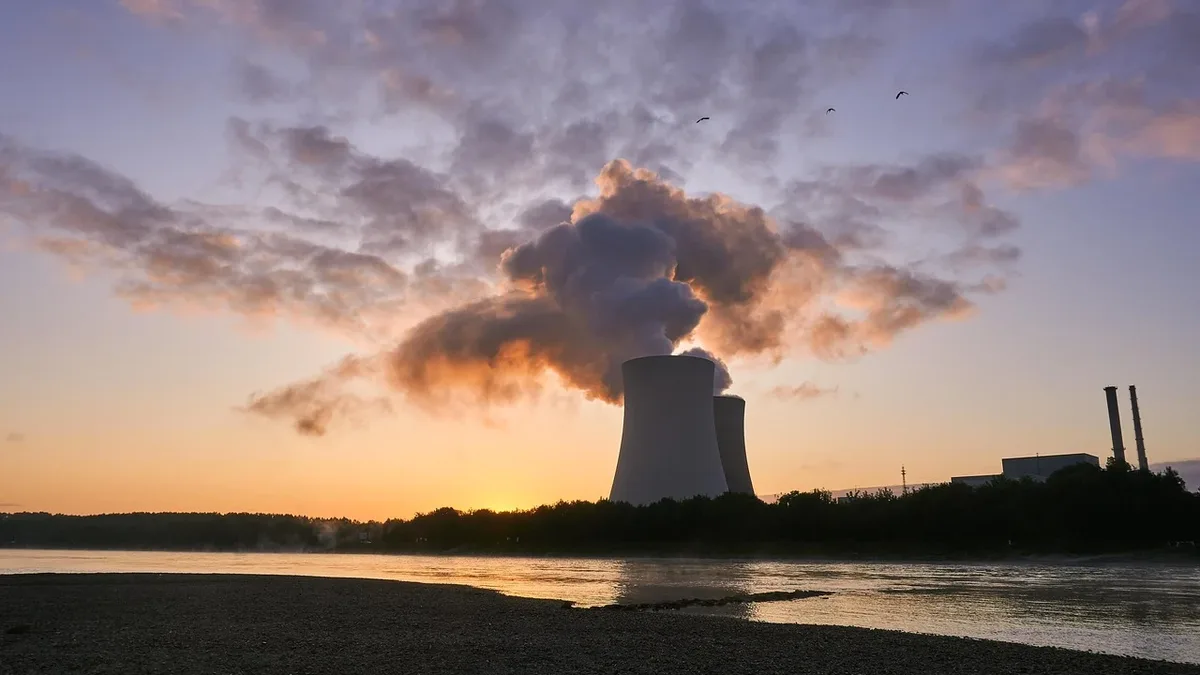
At the heart of the issue is the large supply of water that nuclear plants need to cool their reactors. The problem is most acute in Europe, where many plants rely on rivers, unlike in Asia, where most stations are built near the ocean, or in North America, where reactors more often have cooling towers that help avoid problems with overheated water supplies. Experts say that Europe’s situation has more to do with how its individual plants are engineered and that the flaws are fixable.
“There are multiple solutions to this,” said Madison Hilly, managing director of the nuclear consultancy Radiant Energy Group. But “if you don’t like nuclear, this is the annual occurrence that basically allows you to try … and say, ‘No, actually nuclear is not reliable and it can’t be built for a changing climate.’”
The climate challenge for Europe’s nuclear plants is twofold. First, above-average river temperatures trigger environmental regulations barring the release of water that’s too warm. Second, drought conditions mean that the water levels are too low for the plants’ intake pumps to work. Along the Danube, the intake pumps that pull cooling water into the plant weren’t constructed to handle the low water levels reached this summer. When these plants were designed and built between the 1970s and 1990s, “there was no awareness of the dramatic changes in river flow rates and temperatures that we are witnessing now,” said Jacopo Buongiorno, the director of science and technology at the Massachusetts Institute of Technology’s Nuclear Reactor Laboratory.
Still, he said, “moving the intake is technically feasible, albeit expensive.”
“One has to put things in perspective.” Buongiorno said. “And while all the attention goes to a handful of struggling facilities located on problematic rivers, the vast majority of nuclear power plants go through the summer heat without any issue. Nuclear plants remain the most reliable power generators on the planet.”
The most obvious solution to water levels dropping below the intake pump is, as Buongiorno described, to lower the equipment. It’s difficult to say exactly how much that would cost, since the renovation of the relevant components would amount to a bespoke engineering project.
But virtually every structure at a nuclear plant is expensive, and renovating part of an existing plant typically costs more than building that section from the ground up. Case in point: Most nuclear plants in the U.S. and Asia were built with cooling towers, the hyperboloid structures that are often the most visible component of a nuclear plant and which prevent the discharge of too-hot water. The towers also allow a plant to recirculate and reuse water in a closed-loop cycle. In 2009, a study that Tetra Tech prepared for California’s Ocean Protection Council found that adding a cooling tower to a built plant would cost about $87 million. Accounting for inflation, that would be roughly $135 million today. Such renovations also take years.
The recent disruptions “call for an upgrade in Europe’s nuclear preparedness for extreme climate events that sadly are now a new norm,” said Adam Błażowski, the Poland-based chair of the pro-nuclear climate group WePlanet.
As a short-term solution to the water-level problem, the Hungarian government sank two barges near the Paks nuclear power station, Hungary’s only such plant, to artificially hike the river levels enough to keep water flowing into the plant’s two units.
While “numerous ideas and technical solutions for securing the cooling water needed for operation have appeared in the press and on social media,” cautioned the HUN-REN Centre for Energy Research, a government laboratory for studying nuclear and renewable energy, “reaching a final, well-founded decision requires the professional evaluation of nuclear safety and electricity generation alongside a number of other considerations, navigation, water and agricultural management, flood protection, and so on. …”
“However tempting these proposals may seem from the standpoint of security of supply, economic efficiency, and, should the water level later rise on a sustained basis, the restart of the other units, they conflict with the fundamental principles of nuclear safety and are therefore unacceptable under any circumstances,” the organization said in the statement.
Still, the HUN-REN Centre noted, the problems with specific nuclear plants in France, Romania, and Hungary shouldn’t detract from the critical role nuclear has played in keeping the lights on across the region.
“In these very days, avoiding a collapse of the electricity system owes much to the nuclear power plants operating in the Czech Republic and Slovakia, which are almost entirely identical to Paks NPP but use cooling towers instead of fresh water cooling,” the HUN-REN Centre said. “This also demonstrates that nuclear power plants with different cooling solutions respond differently to extreme hydrological conditions.”
For proof that nuclear plants can be designed to operate in extreme heat and drought, simply look to Arizona.
The three-reactor Palo Verde nuclear plant provides more than one-quarter of Arizona’s electricity. Perennially drought afflicted, the Copper State, now facing fresh cuts to its allotment from the Colorado River under the Trump administration’s plan to ration the region’s dwindling freshwater source, built the plant to run on recycled wastewater from Phoenix, 50 miles away. It could serve as a model for future plants.
“Palo Verde uses recycled water from the city of Phoenix, so it’s pretty much self-sustaining. It’s also an example of brilliant engineering,” Buongiorno said. “They managed to build and successfully operate a three-reactor nuclear power plant in the middle of the desert, without becoming a burden on the city water supplies.”
Alexander C. Kaufman is a contributing reporter at Canary Media, and an award-winning writer who has covered energy and climate change for more than a decade.